Audio practice
One Room for Mixing and Playback
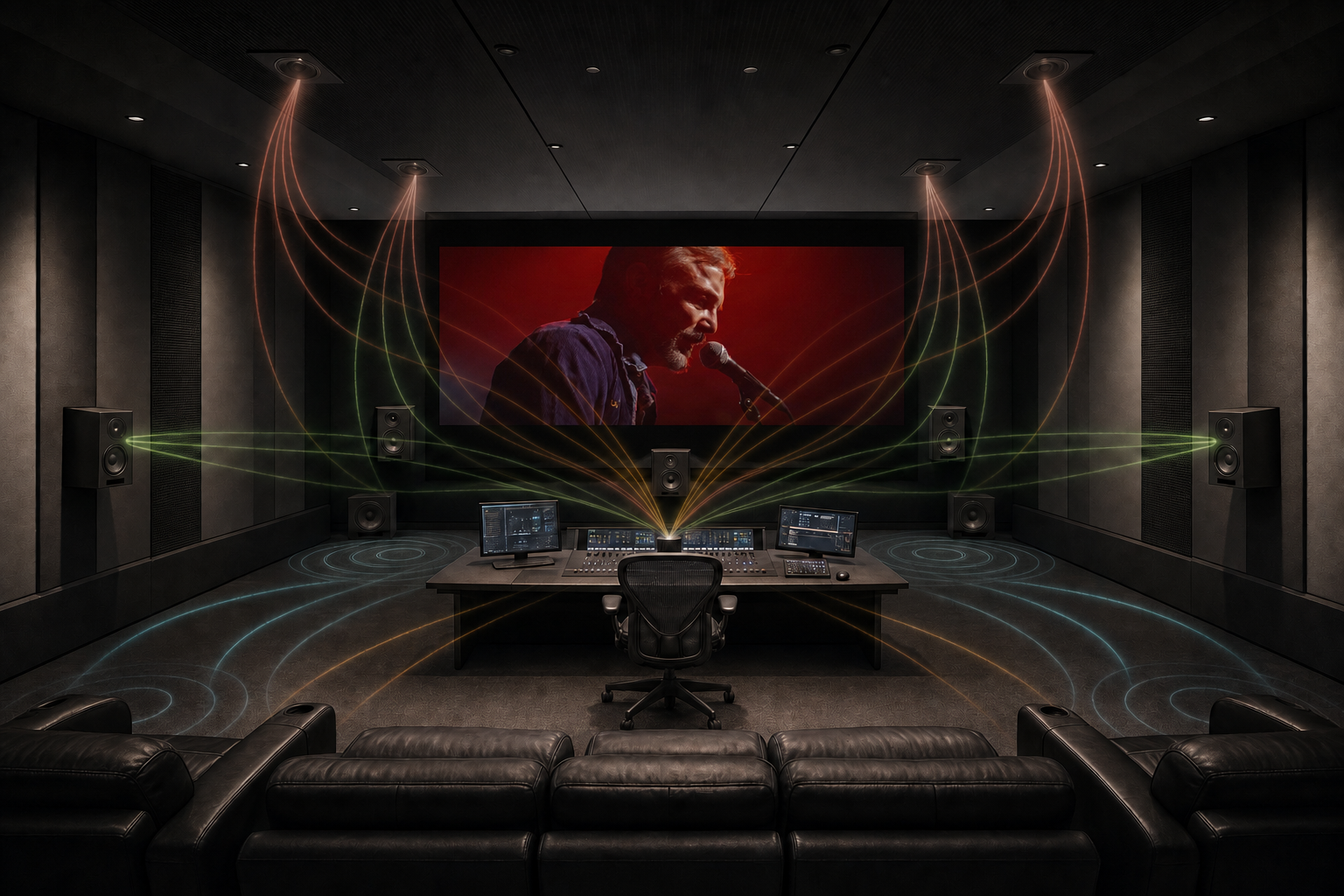
The useful thing about my room is not that it can play Atmos. It is that I master in the same calibrated system where I watch Netflix, Apple TV, YouTube, and Blu-ray.
My work and the commercial releases I use as references reach the same StormAudio processor, the same Genelec speakers, and the same room correction. I can move from my own mix to a film like Dune without changing the system underneath the comparison. I am not trying to remember what the reference sounded like in another room, through another processor, on another set of speakers.
This does not make the room a model of every living room. Nothing could. It removes one variable from the comparison. The source and presentation can change while the playback system stays fixed.
That is the reason I built one room to do two jobs that are usually discussed separately: professional monitoring and consumer playback.
The image side of this same principle is in Calibration Is a Chain, Not a Setting. There too, the useful baseline is the complete installed path, not one device in isolation.
Two sides of the same room
On the professional side, DaVinci Resolve Studio and Fairlight feed SPHERE, alongside computer audio. SPHERE is the monitor-control layer before the StormAudio ISP Elite MK3. In the system as it exists now, SPHERE has three distinct output pipes: 2.0 over TOSLINK optical, 5.1 or 7.1 over HDMI, and 7.1.4 over AoIP.
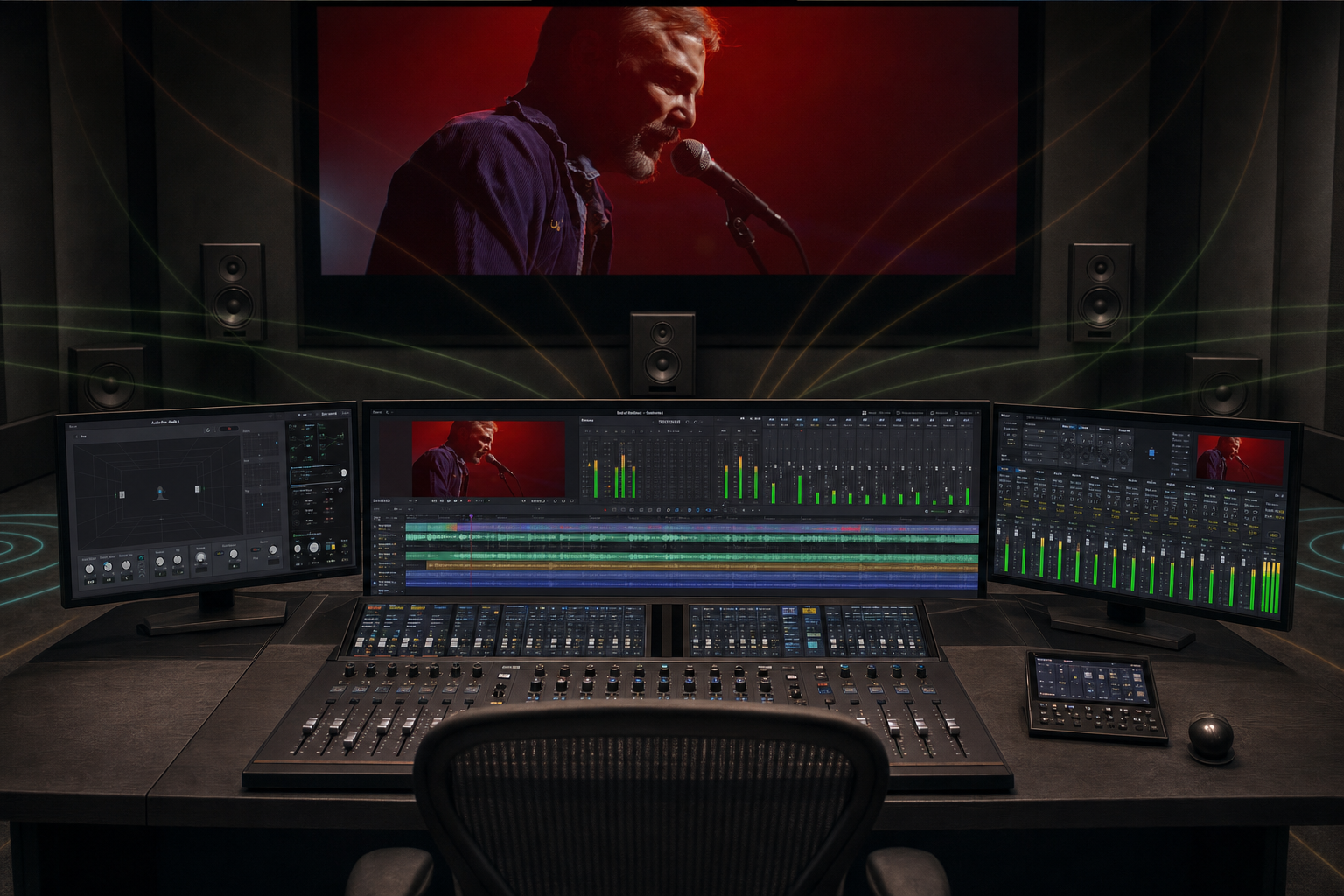
On the consumer side, computer audio enters the same SPHERE-controlled chain. The Storm handles the audio processing before the signal reaches the Genelec system.
The exact connection between Resolve or Fairlight and SPHERE is not important to the argument here. The three current outputs from SPHERE are. I am not labeling the HDMI signal as rendered PCM or an encoded format, and I am not claiming that the 7.1.4 AoIP stream carries live Atmos objects and metadata into the Storm. Here, 7.1.4 names the incoming channel layout, not the installed room.
What is confirmed is simpler:
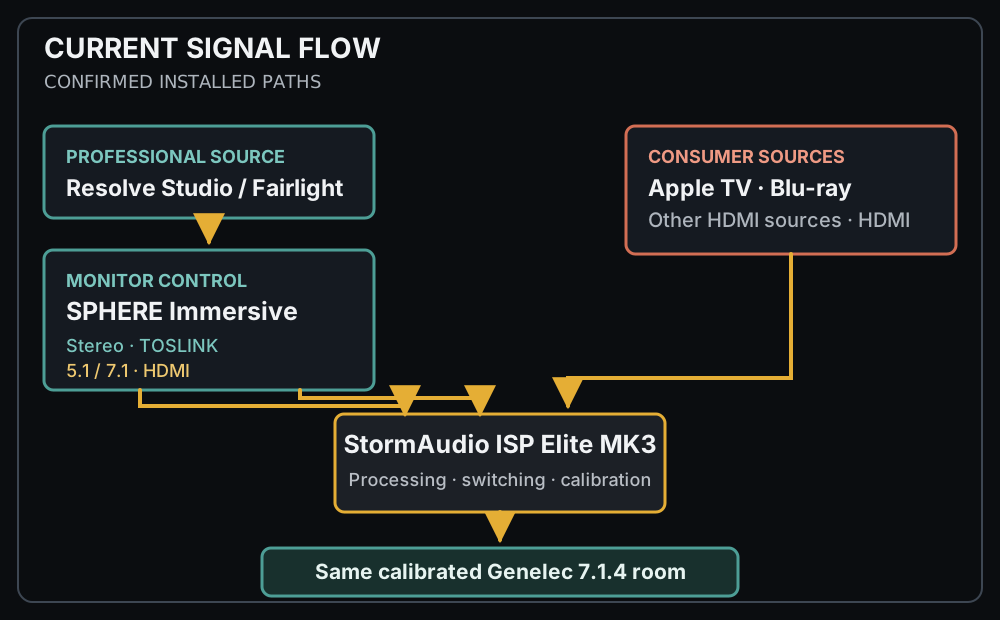
Both sides converge on one playback chain. That convergence matters more to me than the inventory.
A fixed baseline for changing presentations
The Storm, Genelecs, room, bass management, levels, delays, EQ, and calibration sit beneath every comparison. The installed room is 7.4.4: seven bed speakers, four subwoofers, and four height speakers. When I change from my own 7.1 render to a commercial Atmos release, I am changing the source and presentation, not the room.
That makes differences easier to place. If the front stage loses weight, the surrounds stop connecting, dialogue moves, or the bass changes character, I can investigate the presentation instead of first wondering how much of the difference came from another room.
The consistency of the speakers matters too. A spatial move should sound like a sound moving through space, not like a sound changing character because it crossed from one speaker family to another. Similar voicing across the Genelec bed and height channels helps preserve that continuity.
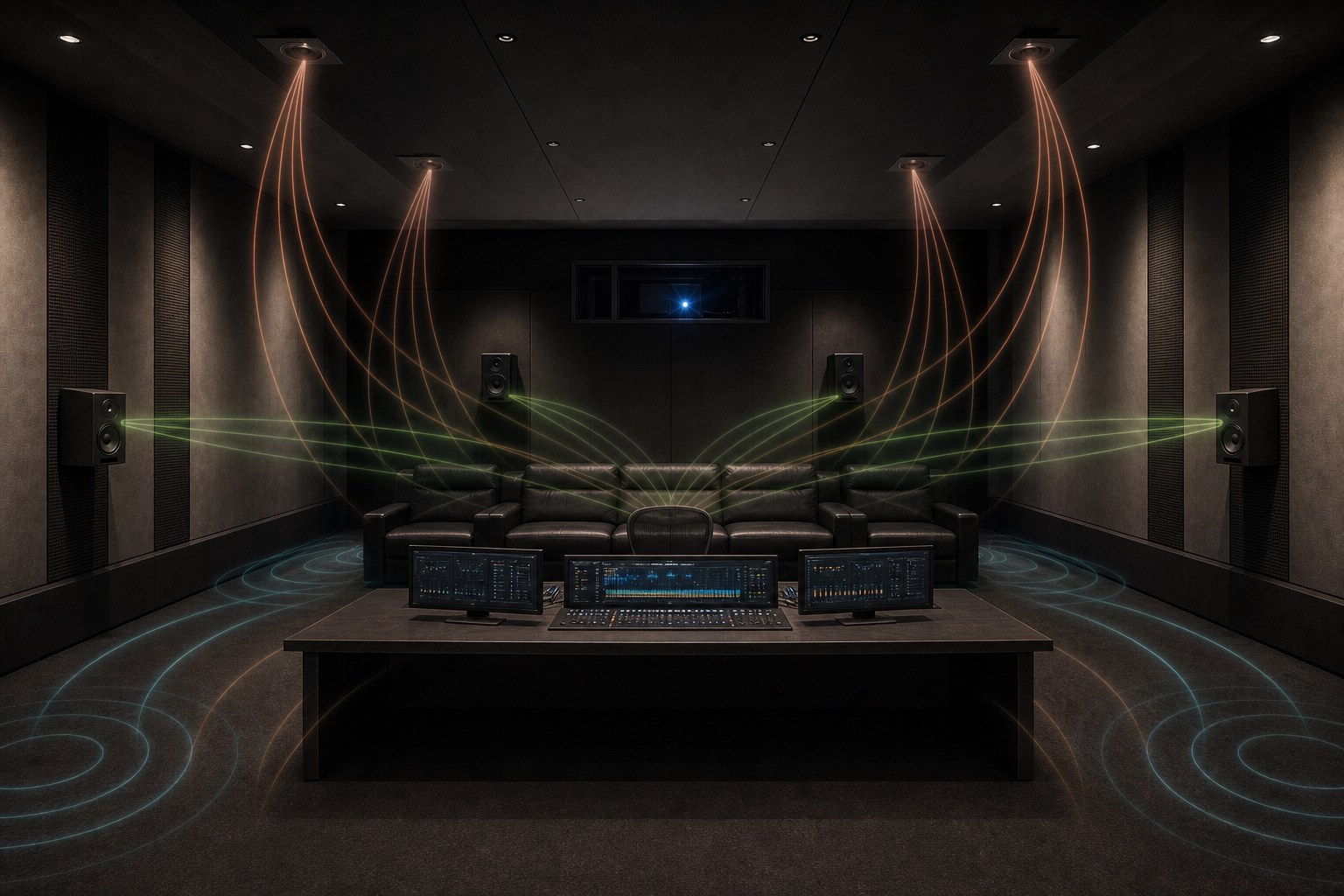
I use the word direct carefully in this room. Direct means I am hearing the channel presentation without adding an upmixer. It does not mean I have removed the calibrated playback system. Bass management, speaker levels, delays, EQ, and room correction remain part of the known baseline unless I deliberately test something else.
That distinction matters because direct listening is only useful when the rest of the system stays known.
Monitoring states, not just routing
SPHERE is more than routing in this room. It holds preprogrammed, tested monitoring states, including theatrical reference-level presets at 83 dB and 85 dB. Those are the levels I use for those checks, not a claim that either number is universal reference practice.
It also lets me solo or mute individual speakers and speaker groups: center only, center off, heights only. That turns the room into a repeatable set of questions instead of a fixed spectacle. Does the dialogue still hold when the center is removed? Is the spatial hierarchy clear when I hear only the heights? Does an element depend on the full array to make sense, or does it remain coherent when isolated?
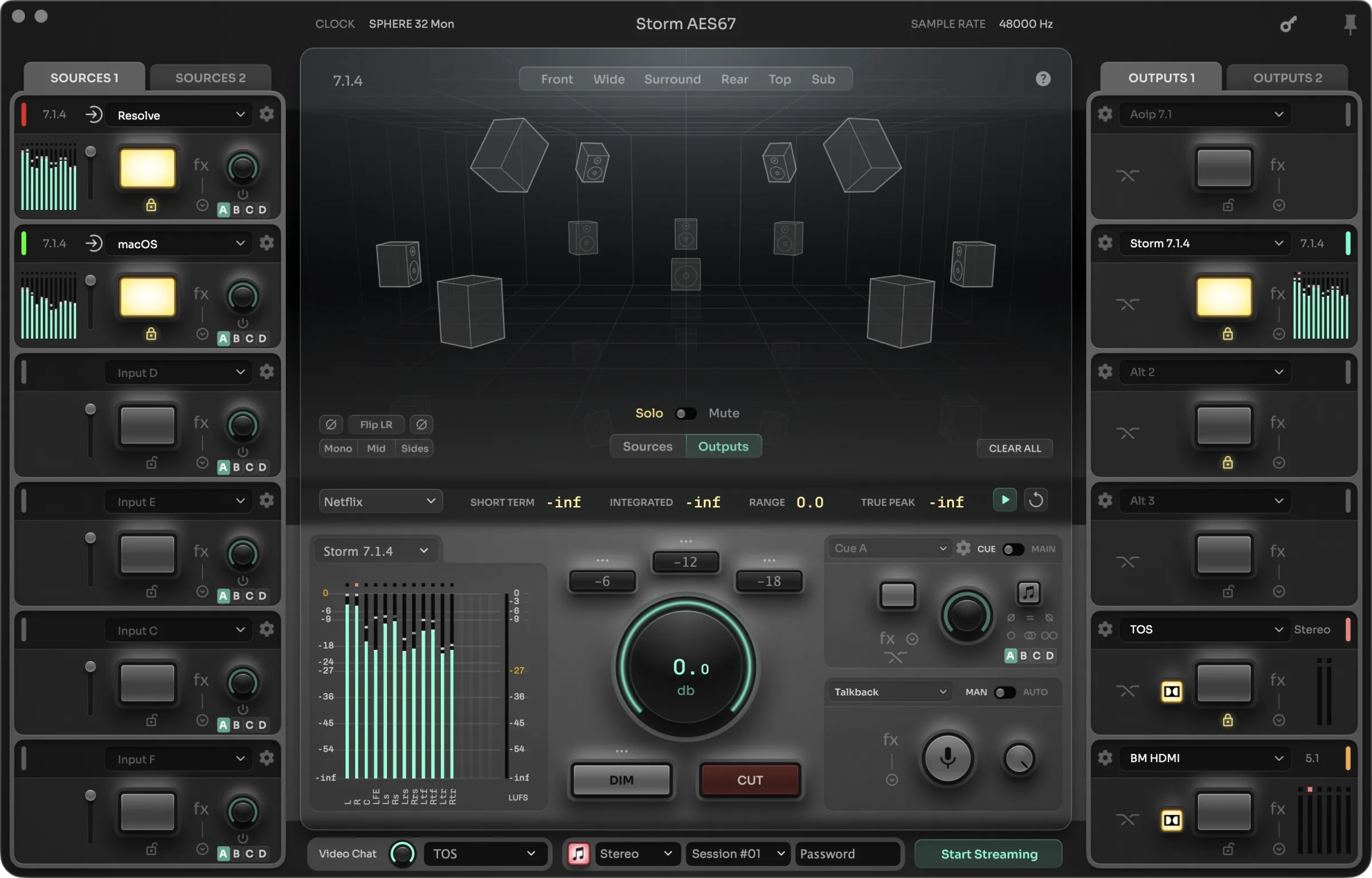
The routing view makes the difference between the workflow and the room visible. Here, Resolve and macOS are active 7.1.4 sources. Resolve is carrying an Atmos mix, and Apple Music on macOS is carrying an Atmos music track. Both are routed to the StormAudio 7.1.4 output. That 7.1.4 label describes the source/output layout in this workflow. The physical room remains 7.4.4.
Direct first, transformation second
I want to hear what the presentation is doing before I ask another process to reinterpret it.
For stereo, I listen to stereo first. For 5.1, I listen to 5.1. For 7.1, I listen to 7.1. If I am checking an Atmos project, I first monitor the native presentation available in the production chain, then I listen to renderer-generated stereo, 5.1, or 7.1 versions as fixed channel renders.
Only after that do I audition consumer transformations such as Dolby Surround, DTS Neural:X, or Auro-Matic.
That order gives each pass a clear question. The direct pass tells me what the authored channel presentation is doing. The upmixed pass tells me what a consumer processor may infer from it.
With stereo, I listen to the center image, dialogue stability, front-stage weight, ambience, bass, and any phase information that may encourage steering. With 5.1, I listen to the hierarchy between the front and surround fields, the continuity of bass, and what an upmixer tries to place behind or above me. With 7.1, I pay close attention to surround continuity, reverberation, and height extraction.
Sometimes the transformed presentation reveals useful spatial information. Sometimes it exposes a phase relationship that sends energy somewhere I did not intend. Sometimes two upmixers disagree. That disagreement is information about how the mix may behave in different consumer systems. It is not proof that one of them has discovered a hidden master.
An upmixed result is not a new Atmos mix. Once an Atmos project has been rendered into fixed channels, the original objects and their adaptability are no longer there. A processor can derive new routing from the render, but it cannot restore the authoring model that produced it.
Commercial releases as live references
The consumer side of the room keeps commercial work close enough to use while I am making decisions.
I can move from my own material to Netflix, Apple TV, YouTube, or Blu-ray without mentally translating between playback systems. A release like Dune can be a reference for scale, front-stage authority, surround density, height use, and low-frequency behavior. I do not treat it as a numeric target or assume my mix should copy its balance. I use it to reset my sense of what a finished commercial presentation can do in this room.
That is different from remembering a movie I watched the night before. Memory is too accommodating. An immediate comparison is less polite.
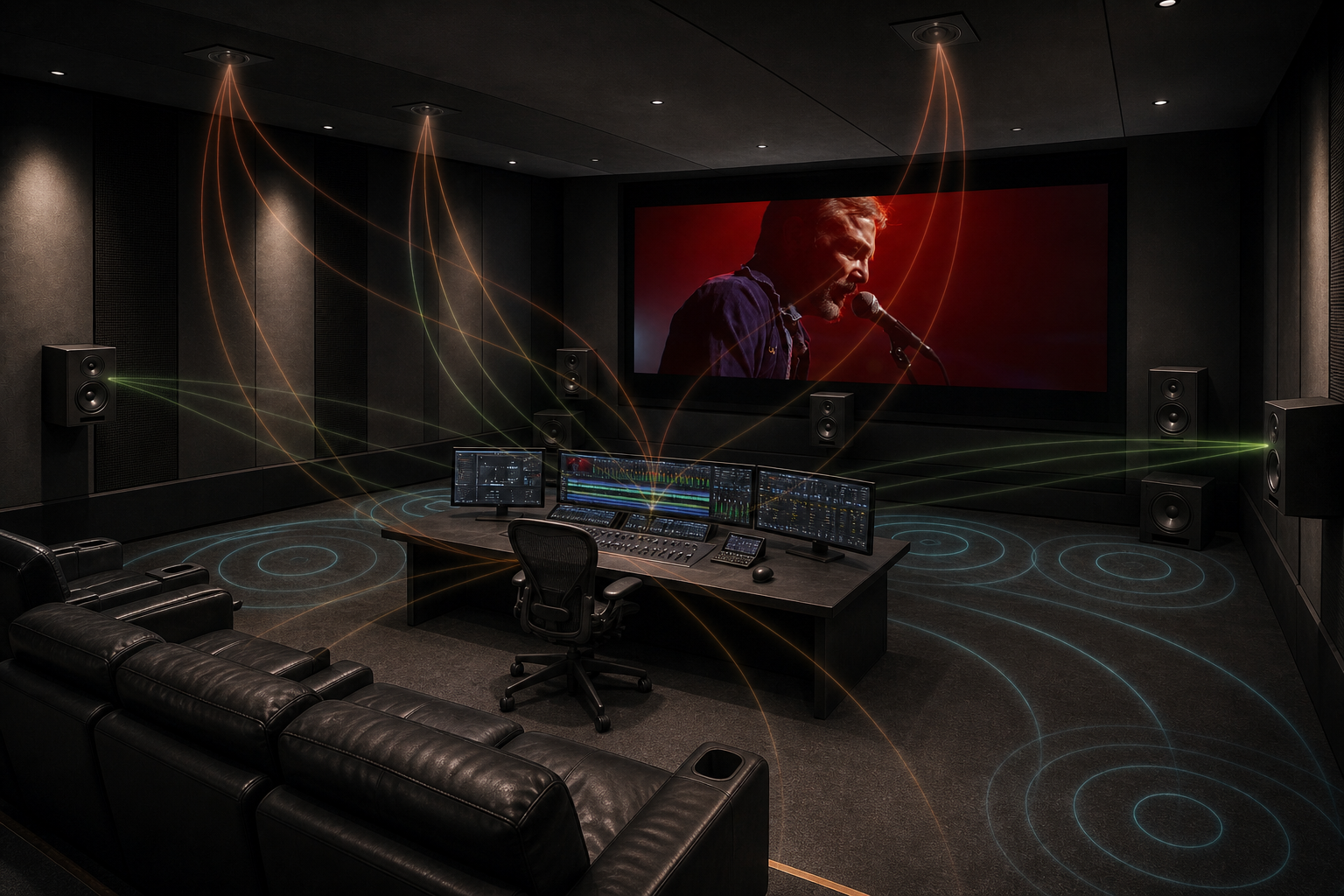
The shared room also makes format losses easier to hear. I can compare a native monitoring presentation with its stereo, 5.1, or 7.1 render, then hear what happens when a consumer upmixer works from that render. I can listen for what survives, what collapses, what becomes exaggerated, and what gets redirected. Dialogue and bass usually tell the truth quickly, but spatial hierarchy matters just as much. A sound arriving from a speaker is not the same as the sound arriving there for the right reason.
This is not an argument that the Storm is superior to every consumer processor or that my room predicts every endpoint. It is a way to hold the playback system still long enough to compare decisions.
Dirac is not one process
The word Dirac often gets used as if it names one correction step. In this system it refers to three related tools with different jobs.
Dirac Live Room Correction addresses the response of the speakers and room, including timing and frequency response across the correction range I configure. In my room, I commonly limit the correction target to roughly 2.5 to 3 kHz and let the Genelecs handle the top end. That is my target choice, not a technical limit of Dirac Room Correction.
Dirac Live Bass Control coordinates the subwoofers and their relationship to the main speakers across the listening area. This is not just a matter of setting a crossover on each channel. It treats the low-frequency system as a system.
Dirac Live Active Room Treatment uses the installed speakers collaboratively to control room decay and low-frequency behavior, generally in the region below roughly 150 Hz. That operating region describes ART's collaborative room-control work. It does not mean ordinary Room Correction stops at 150 Hz.
The subjective result of ART in this room can feel like an "infinite void." That is a description of the sensation, not a measurement. The room seems to release low-frequency energy instead of holding onto it. Bass can be large without the room sounding full of leftover bass.
Keeping the three tools distinct makes the monitoring baseline easier to understand. Room Correction shapes the speaker-and-room response over the chosen range. Bass Control coordinates the low-frequency sources and their relationship to the mains. ART addresses decay and low-frequency behavior by using the speakers together. They overlap in the system, but they are not interchangeable names for the same operation.
The AoIP control workflow I want next
The current professional path already includes 7.1.4 AoIP alongside 2.0 TOSLINK and 5.1 or 7.1 HDMI. What I want next is a better control workflow for that AoIP path.
The improved workflow is about making changing channel layouts legible to the processor. The current AoIP source reaches the Storm; I want to declare its incoming layout in the WebUI as 2.0, 5.0, 5.1, 7.1, or 7.1.4. The processor would then present the direct and upmix choices valid for that layout. I should not have to reconstruct the channel intent each time the incoming presentation changes.
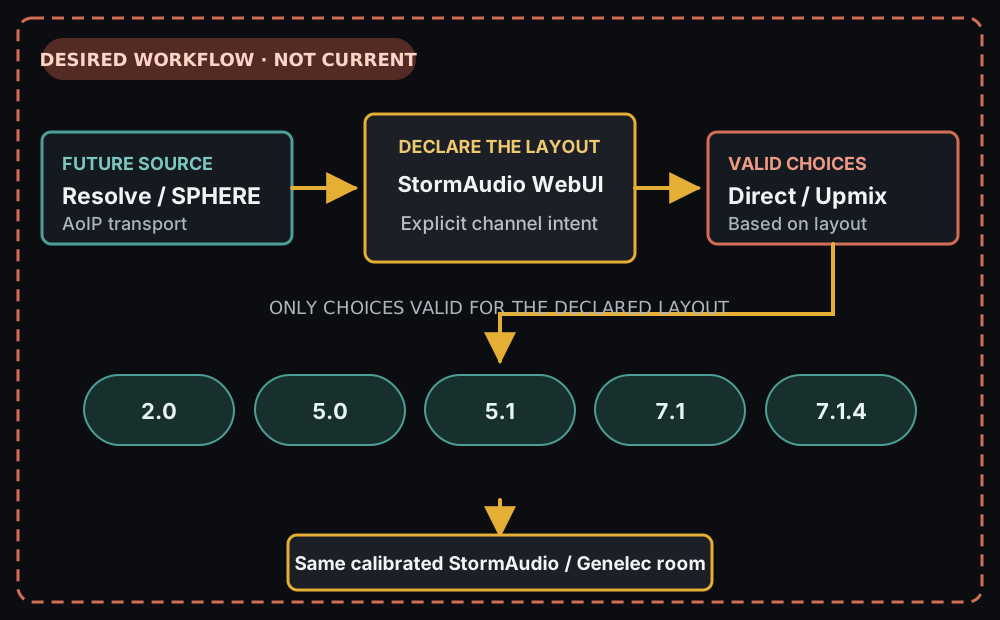
Layout, Audio Profile, and preset are different things here. The layout is the incoming channel arrangement. An Audio Profile is a Storm configuration object that governs audio behavior. A preset recalls a system state. A cleaner workflow may use those concepts together, but the installed system does not yet use presets to declare and switch incoming AoIP layouts this way.
StormAudio's current AoIP input documentation describes two relevant paths. In the documented AES In processed mode, AoIP input accepts up to eight incoming channels in a fixed order and permits upmixing. In bypass or direct operation, as many as 32 incoming channels can be mapped manually into post-processing. The documentation also says the incoming AoIP stream carries no channel-mapping information.
That last point is the center of the desired change. The processor cannot be expected to know whether a set of incoming channels represents 5.1, 7.1, or another arrangement when the transport does not carry that intent. I am not assuming it infers the answer by watching which channels happen to be active or silent. I want the layout to be declared clearly, then recalled cleanly, so the available monitoring choices follow the source instead of requiring a manual reconstruction.
The installed 7.1.4 AoIP output pipe is current. The improvement I am describing is not a speculative transport installation; it is a simpler relationship between declared layout, layout recall, and valid playback choices in the WebUI.
One room, fewer guesses
The room cannot tell me how every listener will hear a mix. It can let me hear my work and the world around it without changing the foundation every time.
That is enough to make the room useful in a way a format list is not. The same processor, speakers, bass system, correction, and acoustic space carry my direct monitoring, fixed-channel renders, consumer upmix checks, and commercial references. When something changes, I have a better chance of knowing which decision changed it.
The current AoIP path already extends that logic to transport. The room is one calibrated 7.4.4 system. The next step is making the incoming layout and its recall just as explicit.